
Georgios Panagopoulos MD | Orthopaedic Surgeon
Reverse Shoulder Arthroplasty

Reverse shoulder arthroplasty is a specialized shoulder joint replacement surgery, in which the normal anatomy of the joint is reversed so that the deltoid muscle takes over the movement of the upper limb when the rotator cuff has suffered severe or irreversible damage.
Key takeaways at a glance
Reverse shoulder arthroplasty is a specialized surgical solution for severe shoulder conditions when the rotator cuff is no longer functional.
It reverses the normal anatomy of the shoulder joint, allowing the deltoid muscle to power arm elevation.
It provides reliable pain relief and significant improvement in shoulder function.
It is mainly indicated for rotator cuff tear arthropathy, failed previous surgeries, or complex fractures.
Proper patient selection and surgeon expertise are critical for optimal outcomes.
Table of contents
What Is Reverse Shoulder Arthroplasty?
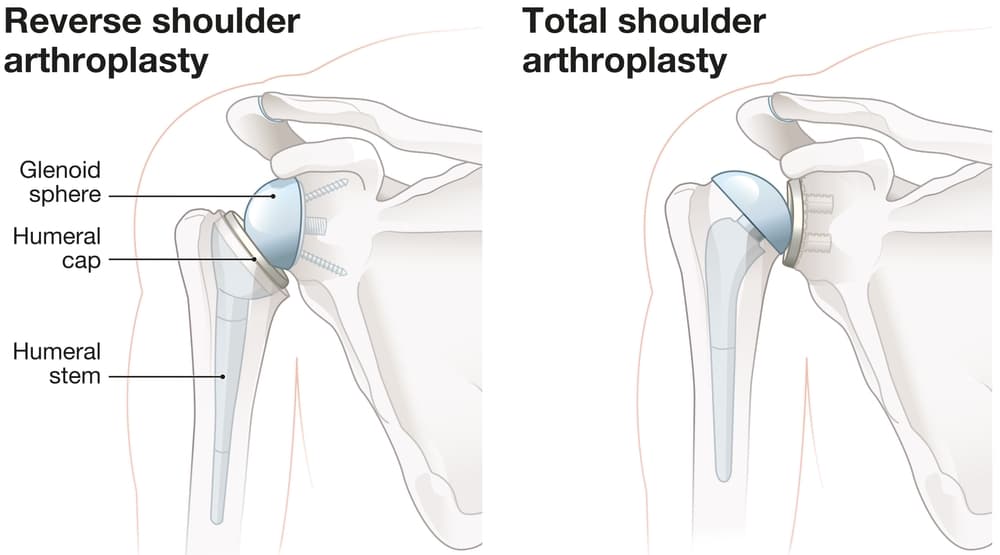
Reverse shoulder arthroplasty is a specialized form of total shoulder replacement. Unlike anatomic shoulder arthroplasty, the ball component is placed on the glenoid (shoulder blade), while the socket is placed on the humerus.
This reversal of the joint’s anatomy allows the deltoid muscle to elevate the arm even in the absence of a functioning rotator cuff.
When Is Reverse Shoulder Arthroplasty Indicated?
This procedure is primarily indicated in the following conditions:
- Rotator cuff tear arthropathy
- Massive, irreparable rotator cuff tears with loss of active elevation
- Failed previous shoulder arthroplasty
- Previous failed rotator cuff repair or failed ORIF
- Complex proximal humeral fractures in elderly patients
- Shoulder pseudoparalysis (inability to actively lift the arm)
- Post-traumatic arthritis
- Fracture nonunion or malunion

Reverse shoulder arthroplasty is not simply an alternative procedure—it is the treatment of choice when the rotator cuff can no longer support shoulder function.

How Does Reverse Shoulder Arthroplasty Work?
By altering shoulder biomechanics:
- The center of rotation is medialized and lowered
- The deltoid muscle gains a mechanical advantage (improved level arm)
- Arm elevation becomes possible without a functional rotator cuff
This biomechanical concept restores functional movement in severely compromised shoulders.
The Surgical Procedure
The operation is performed under general +/- regional anesthesia and typically lasts 90–120 minutes. It includes:
- Removal of damaged joint surfaces
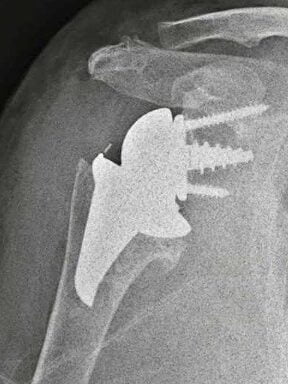
- Fixation of a metallic glenosphere to the glenoid
- Implantation of a socket component on the humeral side
- Restoration of soft-tissue balance and joint stability
This is a technically demanding procedure that requires advanced expertise in shoulder surgery.
Rehabilitation & Recovery
Rehabilitation follows a structured, phased protocol:
- Weeks 0–4: Sling immobilization, passive range-of-motion exercises
- Weeks 4–8: Assisted active motion
- Weeks 8–12: Active motion and strengthening
Most patients:
- Experience significant pain relief
- Regain functional arm elevation
- Return to daily activities within 3–4 months
The success of reverse shoulder arthroplasty is completed through structured rehabilitation and close surgeon–patient collaboration.
Advantages of Reverse Shoulder Arthroplasty
- Reliable pain relief
- Improved shoulder function and quality of life
- Effective solution when other surgical options fail
- Durable, long-term clinical outcomes
Potential Risks & Complications
As with any surgical procedure:
- Infection
- Dislocation
- Implant loosening or wear
- Limited rotational movement
Careful patient selection significantly reduces complication rates.
Why Choose a Specialized Shoulder Surgeon?
Reverse shoulder arthroplasty is a technically complex operation. Expertise in shoulder and upper limb surgery:
- Reduces complication risk
- Improves functional outcomes
- Ensures individualized treatment planning
Modern shoulder surgery is not defined by implants alone, but by correct indication and precise surgical technique.
📌 Reverse Shoulder arthroplasty - Key Facts
- Procedure type: Total shoulder replacement
- Technique: Reversal of joint anatomy
- Primary functional muscle: Deltoid
- Surgical time: ~1.5–2 hours
- Hospital stay: 1–3 days
- Implant longevity: >10–15 years in properly selected patients
In conclusion, reverse arthroplasty is shoulder surgery that involves replacing the shoulder joint with a prosthesis that leads to a reversal of the anatomy, allowing for improvement of the lever arm and deltoid function.
❓ FAQs - Frequently Asked Questions
Is reverse shoulder arthroplasty for everyone?
No. It is indicated for specific conditions, mainly when the rotator cuff is non-functional.
Will I be able to lift my arm after surgery?
In most cases, yes—at least to a functional level for daily activities.
How long do the results last?
With correct indication and surgical technique, outcomes are long-lasting.
Are there activity limitations after surgery?
Heavy lifting and overhead sports activities should be avoided.
When can I return to daily activities?
Most patients regain functional independence within 6–12 weeks.
Find us
Book an appointment with us today